A terrace is an extension of the home and a place where you can enjoy spending time outdoors with family and friends. It is understandable to dream of a beautiful terrace, given that it is a place for relaxation and rest. It can also be a cosy retreat, which is why it should be functional, comfortable and provide a pleasant environment for the household.
The internet is teeming with guides on how to design this area – furniture, accessories and plants. However, the basis of the design concept should be the paving, from which the story of the terrace always begins … One of the most popular terrace surfaces is pavers and concrete slabs. They are a popular choice due to their durability, minimal maintenance requirements and interesting design. The wide variety of pavers and slabs available on the market makes it easy to choose the best solution for your dream design. In the case of pedestrian walkways, which include terraces and paths, there are generally no special requirements regarding the technical specifications or thickness of the pavers and concrete slabs. The standard thickness is 4.5 cm, but there is nothing to stop you from using thicker elements. On terraces and garden paths, you can use minimalist, large-format modern slabs, but you can also opt for interesting and eye-catching patterns. Large slabs can also be laid using the step-by-step method, which works perfectly on paths. Such arrangements look impressive and are environmentally friendly at the same time.
A plan for large formats
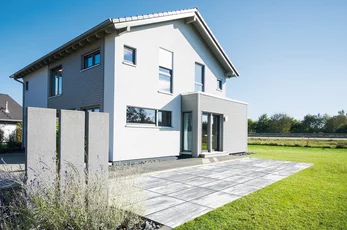
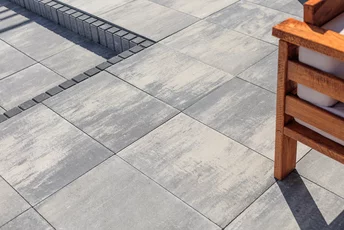
Large format is a great choice for terraces and paths around modern homes. Large-format slabs have been one of the leading trends for several seasons now. It’s a ‘pure’ solution for anyone who loves minimalism and dislikes ‘over-the-top’ designs, unnecessary decorations and ornaments. Here, it is worth noting the Polbruk Plano Mix slab. This is an interesting design concept, as it is based on a system of elements in three large sizes: 80x50, 80x40 and 80x30 cm. The collection is complemented by square slabs with a side length of up to 80 cm! The Plano and Plano Mix tile collection is available in two textures and five colours – in the smooth version, these are greys: the melange nerino, graphite monochrome, and the melange ivory in warm beige tones; whilst in the finely washed version: inez and ardo, which are further shades of elegant greys. Large-format slabs can also be produced in smaller sizes – in which case they usually take on a more classic style.
Modern classic
The Lamell terrace slab boasts smaller, yet still substantial, dimensions. It measures 40x60 cm and has a thickness of 4.5 cm, designed for pedestrian traffic. It features a minimalist design, yet is versatile enough to be used in arrangements that go beyond modern or classic styles. This is thanks to the available colour range. Lamell comes in two textures: smooth and fine-washed. The former is available in five colours. Three are greys – nerino, basalt and graphite, and two are beiges: ‘ivory’ and ‘latte’. The fine-washed texture comes in ‘bianka’ and ‘ritmo’. The greys complement both modern and classic interiors perfectly – the risk of a colour faux pas is negligible here, whilst the beiges are ideal for rustic settings and Mediterranean-style interiors.
With a touch of avant-garde
Aside from large formats, it is also worth paying attention to other tiles designed with modern interiors in mind. Among these interesting options are the tiles Polbruk Bosso and Bosso Trapez. They form a complementary range comprising large-format square tiles with a side length of 60 cm (Bosso) and trapezoidal tiles measuring 60x40/20 cm (Bosso Trapez). Both look excellent on terraces and paths in the entrance area and in the garden. Squares are a classic, whilst trapezoids add a touch of avant-garde to the home environment. When laid over large areas, the latter create unexpected, mesmerising patterns reminiscent of diamonds or geometric vases. A surface laid with slabs of this shape becomes unique, whilst also looking very striking. Bosso and Bosso Trapez slabs come in two shades of grey: nerino and graphite, which are most commonly used in modern designs but also work perfectly in classic schemes. Both are available in two thicknesses, 4.5 and 8 cm, with the 4.5 cm thickness being ideal for terraces and paths.
Step-by-step guide
If you decide on a terrace made of large-format slabs from the Plano or Bosso collections, or Lamell elements, it’s worth thinking about garden paths straight away. All the more so because the slabs chosen for the terrace can be used to build garden paths. Simply lay them at a distance of roughly a human stride apart, i.e. approx. 60 cm, and fill the gaps between the slabs with fine gravel in a matching colour. This laying method is known as the step-by-step method. It is environmentally friendly, as the gaps left between the slabs allow for natural water retention and enable rainwater to seep deep into the soil. Paths laid with large slabs using the step-by-step method look very attractive; they add depth to some paths and an undeniable charm to all.
Herringbone pattern on wallpaper … and on the terrace
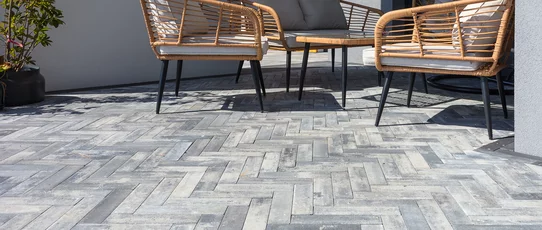
Large-format or unusually shaped slabs are not the only way to create an inspiring terrace surface. It is also worth experimenting with the arrangement of the elements. Interior designers often choose panels or parquet laid in a herringbone pattern for the living room floor. This motif is currently very fashionable and can also be found, for example, on wallpaper, wall panels, ceramic tiles and even on furniture. To visually extend the living room into the terrace space, the herringbone pattern can also be used on the terrace surface. Polbruk Metrik pavers are ideal for this. These are long, narrow elements measuring 28x7 cm, available in fashionable shades of grey – nerino, and graphite, as well as in the colour korten, a shade of rusty sheet metal korten that is very popular in modern architecture. They can also be used to visually enlarge the space and ‘extend’ pathways. In this case, they should be laid in the traditional way, i.e. with the shorter side alternating along the path.
Mosaic – a cure for boredom
Mosaics also have their loyal fans. Not everyone likes endless, minimalist surfaces and prefers spaces where there is more “going on”. Mosaic is a versatile and timeless pattern that has stood the test of time for many years. Of course, not all mosaics are created equal. An attractive option in terms of form, tile size and colour scheme is the mosaic tile Polbruk Toledo. The tiles come in four sizes – the smallest measures 15x15 cm and the largest 30x45 cm – and in nine colours. Seven of these are melanges, whilst the remaining two are solid colours. The palette is dominated by shades of grey: grey, taupe, nerino, boho and graphite. There are also beiges, such as ivory and latte, as well as browns, namely cortado. The wide variety of colours and sizes of the pavers allows for the creation of unusual, geometric patterns or the highlighting of specific areas of a terrace or paths.
Porcelain tiles are also an option
Porcelain stoneware tiles can also be an attractive addition to outdoor designs made from concrete pavers and slabs. They are recommended where the lightness of the elements and the ability to dismantle them are important. This year’s new additions to the range at Polbruk are highly recommended – porcelain/ceramic tiles Tono and Cerro. These tiles are frost-resistant and non-slip. They can be laid directly on a compacted sub-base, but also on pedestals. Tono and Cerro are large-format tiles; they are square in shape with a side length of 59.3 cm and a thickness of just 2 cm. Both are in shades of grey and have a matt finish. They differ, however, in their patterns – Tono resembles stone, whilst Cerro resembles trendy concrete. They have a minimalist look and are ideal for terraces, balconies and patios; they can be successfully combined with other products from the Polbruk range.
There is nothing to stop you from taking something from each concept for your garden. Here, however, you should be guided by the principle of moderation. The terrace and garden should always match the style of the house, but they must also harmonise with the personalities, tastes and passions of the household members.