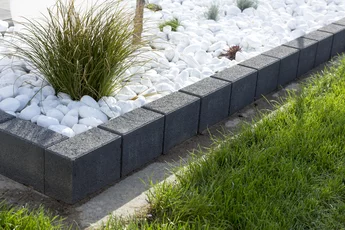
They mark the boundaries of paths and walkways, prevent soil from spilling out or plants from being trampled, and are also used to create flowerbeds – edging, as we are discussing, serves a variety of functions around and in front of our home.
Concrete is currently very popular in the design of outdoor spaces around modern homes. Today, concrete precast elements are used to build alleys, paths, pavements, terraces, driveways and small architectural features. This is why concrete edging is a natural complement to contemporary garden designs. Moreover, they boast excellent technical specifications, guaranteeing their durability and impeccable aesthetics for years to come. Add to this the fact that they require virtually no maintenance, and concrete edging becomes the number one choice, leaving competitors made of wood or plastic far behind. When we combine this with the multitude of designs available on the market, which vary in height, thickness, length, texture and colour, we end up with a material that blends perfectly into almost any garden scheme. But let’s start with the basics.
To keep everything in order!
The primary function of edging is to protect paving or green areas, which is why it is used at the edges of paths, pavements, roads, driveways or green spaces. Properly installed edging stabilises the surface, preventing it from spreading outwards. Thanks to edging, the surface retains its durability and aesthetic qualities for much longer.
They effectively demarcate zones
They also play an important role in clearly demarcating pedestrian zones from vehicular zones, or traffic areas from urban green spaces. This is particularly evident at the junction of a road and a pavement, where kerbs are often laid alongside standard kerbs; by surrounding the green area, they prevent cars from driving onto it and parking on the lawn.
They prevent soil erosion
Edging is also useful for securing slopes and preventing soil erosion. Although most edging is no more than 30 cm high, when placed at the bottom of a slope, just in front of the pavement, or along the sides of the slope, it fulfils this purpose perfectly.
They create flowerbeds!
We can use edging to create flower beds or herb gardens. In this case, edging serves as a protective element and clearly defines the boundary between different areas of the garden.
Functional and stylish solutions
Edging such as Modern and Treo is ideal for the applications mentioned above. Their height does not exceed 30 cm. Each of them, thanks to their subdued colour scheme in shades of grey and brown, as well as their minimalist design, will work well in practically any arrangement, and particularly in modern designs. Although at first glance these edging tiles may appear identical, they are in fact quite different. Modern has a smooth texture, a height of 28 cm and consists of six trapezoidal elements. This allows for the construction of straight sections and curves, offering even greater design possibilities. Another interesting solution is Treo. It features a fine-grained or smooth texture. The distinctive features of Treo are the vertical lines that visually divide each element into three parts, as well as the chamfer running along the upper edge of the prefabricated element.
They allow for an attractive finish to stairs
Some of the edging can also be used to finish stairs in the entrance area or on a terrace. This is a practical and quick way to level out differences in ground height. Due to their dimensions, the edging Modern and Treo are ideal for this purpose.
Standard edging, or perhaps a wider one?
The most popular width for edging is 6 to 8 cm, but 10 cm variants are also available on the market, the best example being the aforementioned Lingo. Such thicker and more substantial edging provides an excellent finish for modern surfaces laid with large-format slabs. Wide edging is undoubtedly a decorative element in its own right, so it is worth considering it not only from a functional perspective but also appreciating its interesting design.
As you can see, edging plays a vital role in the layout of the space around a property. They stabilise the surface, are used as retaining elements, help to organise the space more effectively and create small-scale architecture, as well as forming part of the garden’s ‘furnishings’. They are an extremely important detail that will add not only functionality but also style and elegance to the space.