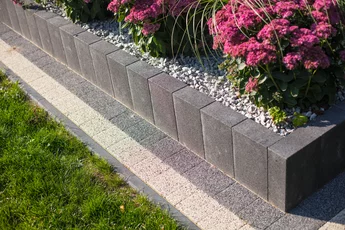
Why do some properties immediately catch the eye and delight with their appearance at first glance? Is it down to well-chosen plants, a match with the style of the house, and the tidiness of the space? Yes, but not only that! A beautiful property is one where every element works in harmony, and any imperfections in the terrain are concealed or, on the contrary, skilfully highlighted. For such tasks, it is worth using simple and proven solutions, such as the Hestra palisade. Its simple form offers investors and contractors a wealth of possibilities – see for yourselves!
Palisade – a product for special tasks
A palisade is an element of small garden architecture. It is widely used not only on private properties but also in public spaces. It is most commonly used to separate areas, e.g. flower beds from vegetable gardens, driveways from lawns, and recreational areas from utility spaces. This product is also used to mark out paths and create an attractive route for them. It is an excellent alternative to traditional edging and is therefore ideal for ‘enclosing’ areas made of pavers (terraces, steps, etc.). Owners of properties with uneven terrain often choose palisades to create functional retaining walls.
Hestra on the property
The Palisade Hestra is a functional and highly decorative product that can be used with confidence on the property in both modern and traditional styles. It is available in five heights: 40, 60, 80, 100 and 120 cm. By combining them, you can create structures with a unique character. We are talking about various types of flower beds or planters. An additional advantage of this palisade is its subdued colour range: grey, graphite and brown. This makes it easy to match it to previously selected decking boards or pavers. The colours can also be combined to create original compositions.
It’s simple!
In this case, ‘less is more’. The simple, even austere design of the Hestra palisade means it can subtly emphasise the character of its surroundings without overwhelming the vegetation. The product discreetly showcases its beauty, whilst also being resistant to external factors. Properly laid and secured, it will delight with its functionality for years to come! Paver, this is your job! Fortunately, laying palisade walls is very easy. The most important thing is to level the blocks properly and secure them firmly. This means that each element must be levelled separately and set in a special ‘thin’ concrete layer approximately 10 cm thick on each side. The depth of embedding in the foundation should be between ¼ and 1/3 of the length of each block.
.png)
A few important tips for the professional
Firstly: in the case of palisades, the resulting gaps should not be filled with anything. The Hestra palisade has a delicate chamfer. Secondly: if the client wishes to install the palisade in the garden to separate areas of the same soil type with a slight difference in level, you can dig the palisade elements directly into the ground (to a depth of approx. ½ the height of the palisade). This rule also applies to creating borders for flower beds.
Naturally, this year!
If your client dreams of enjoying original solutions on their own property before the year is out, be sure to tell them about the palisade Hestra. The sooner you get started, the better. Plants planted in May will flourish at the turn of spring and summer and will delight with their charm throughout the season. Their beauty will be highlighted by striking borders made from palisades Polbruk. So – let’s get to work!