An adventure with laying pavers Petra described by Aleksandra, author of the Brzezinkowe blog
Aleksandra, the author of the @brzezinkowe
profile, turned 30 in September and is soon to become a mum. She finds fulfilment as a Quality Manager at a prestigious company, and after hours, together with her husband, she is renovating an over 80-year-old wooden cottage, which we received as a wedding gift from our parents.
Aleksandra and her husband are lovers of the countryside. As soon as her in-laws offered them the gift of an old wooden cottage, they knew without hesitation that this would be their place on earth. From the very beginning, the author saw enormous potential in the cottage, so demolishing it was out of the question.
Petra – love at first sight
Aleksandra: You know, we have Petra Onyx by Polbruk
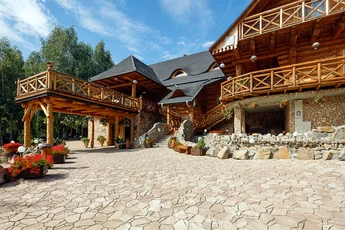
around the house – it was love at first sight. We were captivated by Petra’s uniqueness and the possibility of laying it without using edging (we wanted to blur the boundaries between the garden and the driveway). We searched for a long time for an unusual solution that would emphasise the uniqueness of a rustic wooden cottage.
When making our choice, we considered another product from the range Polbruk Carmino Latte
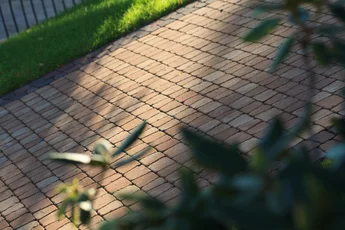
– an aged version with a classic form reminiscent of old cobblestones, in a colour scheme of browns and greys. But it lacked that ‘certain something’. We decided to take a chance and see for ourselves the effect of cracked earth paired with a wooden façade.
A unique design
We were surprised at how perfectly Petra
blended into the rural idyll. It is a paver with a non-standard shape. Although it imitates cracked, desert earth, it blends perfectly with the wooden cottage. We like original things that evoke different emotions in people – like works of art –Petra
is like a work of art; it creates a unique visual effect around the house that cannot be replicated. The unique pattern of cracks gives the garden a certain painterly quality – just like in expressionist paintings. Its colour palette is an added bonus – greys and browns are my favourite colours – the brown complements the wooden cottage beautifully, whilst the grey is echoed in the stone pillars by the gate.Petra
perfectly reflects my character; despite a certain harmony of form, it creates an artistic, ambiguous chaos. It works brilliantly in all weathers; it’s durable, sturdy and practical, despite its uneven surface.
Doing it yourself doesn’t mean it’s difficult!
Why did we decide to lay it ourselves? Well, the answer is simple: after three teams of professionals turned us down (they were put off by the irregular shapes), and after calculating the costs and drawing on my husband’s experience, we came to the conclusion that we could manage it ourselves. Contrary to appearances, laying Petra ourselves was no problem for us. Its large dimensions and the simplicity and repeatability of the pattern meant that the work went quickly and smoothly.
How do you go about it?
We carried out the paver design and calculations taking into account the type of soil, anticipated loads and the drainage method. We marked out the areas and established the levels (transverse and longitudinal gradients) by placing stakes at the boundary points of the area, referencing the edge of the terrace and the house’s foundation.
The second stage was preparing the sub-base, which begins with removing the soil – for this purpose, we hired a backhoe loader. Depending on the load and the properties of the sub-base, the foundation for the pavers consists of a base layer between 15cm and 45cm thick; in our case, it was 30cm (22cm of ready-mixed concrete + 8cm paver thickness). We thread a visible string through the previously prepared stakes and position it according to the pre-marked heights at which the pavers are to be laid, ensuring the string is taut. We then ordered a ready-mixed dry concrete (depending on the intended use, e.g. 7.5 MPa for a driveway, and 5 MPa is sufficient for the house plinth), which we spread ourselves and levelled using tubes, setting them according to the thickness of the pavers (the Petra
s are 8 cm thick, so we set the tubes to 7.5 cm). Once the bedding has been laid, it should be levelled mechanically using a metal screed. Then compact it with a vibrator and level it again.
After waiting a few days, we set about laying the Petra pavers. The stones should be laid on the bedding so as to maintain 2–3 mm gaps between individual elements. Roughly every 2 m, we used a string to check that the lines of the paving joints and the levels were correct. Once checked, the joints are filled with dry concrete, which prevents the rows of pavers from shifting further. After laying the pavers, they should be compacted in such a way as not to compact the surface in localised areas. Compaction is carried out transversely to the laid pavers until a level surface is achieved.
The final stage is filling the joints between the elements. We filled them with dry concrete. Polbruk recommends grouting in accordance with the conditions for proper installation.