It is of key importance when selecting material for paving. – The thickness of the slab or concrete block determines its durability, as well as the type of loads it is designed to withstand. The rule is simple – the thicker the paving block, the greater its strength and resistance to heavy vehicle traffic,” says Krzysztof Wilk, Chief Technologist at Polbruk S.A. The concrete precast elements used to lay the surface can be divided into three groups. Those less than 6 cm thick can only be used for footpaths, i.e. terraces, alleys and small courtyards within the garden. If we anticipate that vehicles weighing up to 3.5 tonnes will be moving across the surface, slabs or pavers with a thickness of 6 to 8 cm should be used. Conversely, only paving elements over 8 cm thick can withstand the weight of heavy vehicles weighing over 3.5 tonnes. Although at first glance this seems like a significant inconvenience and a limitation on creative freedom, this is not the case at all. The range of concrete blocks and slabs available from leading manufacturers on the market is constantly expanding. They are extremely diverse not only in terms of their design but also their technical specifications, such as dimensions and thickness, allowing you to select the optimal solution for almost any layout or project.
Best for the garden living room
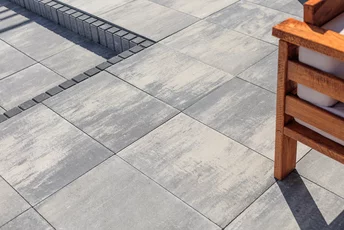
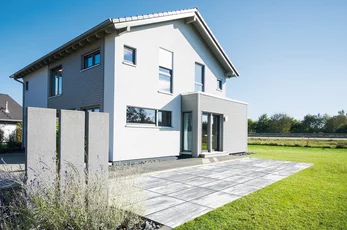
A terrace is usually an extension of the living room, so it is extremely rare for any vehicles to drive onto it. It is an area intended strictly for relaxing with family or friends during the spring and summer months. If you intend to lay a terrace surface using concrete slabs, it is best to use elements up to 6 cm thick. – Most slabs designed for terrace areas are around 4–4.5 cm thick, which is sufficient given how they are used. In this case, we can also use thicker slabs, although this will require more work in preparing the substrate for laying them – emphasises the Chief Technologist at Polbruk S.A. Terraces are usually quite large areas, which is why the most commonly used and most fashionable slabs are those with large dimensions.An interesting solution that can be used in modern designs is the slab in shades of mottled grey: Polbruk Lamell. It comes in as many as 10 colours – with both smooth and washed textures. It measures 60x40 cm and is 4.5 cm thick, making it ideal for use as a decking slab. Of course, these are not the only options. There are truly many possibilities, and it is entirely up to our creativity and taste which option we choose for our dream design.
Driveways – are there any universal solutions?
The situation is slightly different when selecting paving elements for a driveway. In this case, we must decide right from the start how heavy the vehicles will be that will be using it. If we plan to use the area next to the house solely for parking a passenger car, a surface made of slabs between 6 and 8 cm thick will be perfectly adequate. However, we should bear in mind that not all 6 cm thick slabs are suitable for a driveway. Their dimensions are also important. The intended use of the slabs can be easily checked in the so-called declarations of performance, which every manufacturer provides. If the home parking area is to be used for parking machinery, including construction or agricultural vehicles, it is worth investing in slabs over 8 cm thick. We should take a similar approach if we know that the surface of the home car park or driveway will be used frequently and it is difficult to predict what types of vehicles will be parked there. This is a safer solution, as thicker paving elements simply ensure greater durability and resistance to mechanical damage caused by heavy vehicles, such as fire engines. Sometimes, when planning the layout of the site, particularly if there are outbuildings next to the house that need to be accessed by vehicles weighing over 3.5 tonnes, paving elements of varying thicknesses are used. On the route taken by heavy vehicles, a surface made of 8, 10 or 12 cm elements is then laid, whilst on the remaining areas, the thickness ranges from 6 to 8 cm. – An example of a product that can be used in this type of project is the ‘Polbruk’ slab Magna, available in two thicknesses: 8 or 10 cm – says Krzysztof Wilk. Magna, due to its large-format nature (it measures 50x75 and 75x100 cm), can also be successfully used as a terrace surface, making it an extremely versatile solution. Its wide range of colours also contributes to its versatility. The tiles are available in shades of mottled grey, coffee with milk and Corten steel. This makes them suitable for both modern (nerino, korten) and Scandinavian (nerino and latte) styles.
The choice of paving style is an extremely important element in the design of the outdoor space around the home. Equally important is the thickness of the paving elements, which must be selected to suit the specific characteristics of the site and its intended use. This is crucial not only in terms of the durability of the paving, but also for maintaining its impeccable appearance and aesthetics for many years to come.
What for the terrace? What for the driveway? It’s not just about design
Add to favorites
Shape, colour and consistency with the architectural style of the house and its surroundings are the basic criteria we follow when choosing concrete blocks or slabs. However, their technical parameters are also extremely important, particularly their thickness.