It turns out that this is not necessarily the case. When choosing concrete pavers or slabs, we must bear in mind a few basic principles to follow. This will enable us to purchase high-quality products that meet technical specifications, with the correct thickness and format, and are appropriately selected for the type of substrate and location of use. This does not mean, however, that choosing precast concrete products is an incredibly complicated process. Nevertheless, there are a few important aspects to bear in mind. The first of these is the quality of the material. – This is extremely important. There is currently a wide range of concrete blocks and slabs available on the market, featuring a great variety of designs. You should always check whether the material you have chosen meets the standards and has the appropriate approvals. The presence of the CE mark on the label attached to the pallet is a guarantee that we have chosen a product of the highest quality,” says Krzysztof Wilk, Chief Technologist at Polbruk S.A. That is why it is worth asking the seller about this aspect. As in any industry, the manufacturer’s reputation also counts. Once we have made our choice, we need to think about what we would like to build. Will it be a terrace, a path, or perhaps a driveway?
Thickness matters
Pavers and slabs differ in thickness. This parameter determines the suitability of a given material for creating a surface for a specific purpose. The rule is simple – the thicker the paver, the greater its strength, and it can support
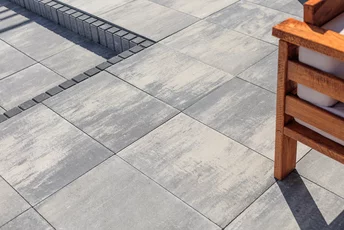
heavier vehicles can travel on it. Therefore, the precast concrete elements used to lay the surface can be divided into three groups. Elements up to 4 cm thick are mainly used for laying terraces. An example of such a slab is Polbruk Lamell, measuring 60x40 cm and 4.5 cm thick, which comes in two textures and a range of grey shades. Products 6 cm thick have a wider range of applications. They are most commonly used for finishing garden courtyards and paths, as well as ground-level terraces.
Another group of pavers and slabs consists of those with a thickness of 7 to 8 cm. These can be successfully used on footpaths and mixed-use paths, which are used by passenger cars weighing up to 3.5 tonnes.
– They are very versatile. Alongside tried-and-tested solutions, such as the paver Polbruk Ideo, which has found very wide application in both domestic gardens and public spaces, we are introducing new products to our range. Among these, it is worth noting Polbruk Magna, a rectangular slab in shades of grey. “This colour scheme is extremely popular in modernist projects, but Magna in the colour korten will also work perfectly with them,” says Krzysztof Wilk of Polbruk S.A. “If we are going to park agricultural machinery or lorries on the driveway to the garage or car park, we must invest in paving elements over 8 cm thick. When laid correctly, they will withstand heavy vehicle traffic for many years. We now know what thickness of paving elements we need to choose to meet our expectations regarding the surface’s durability.
Shape, size and colour scheme – these are also important
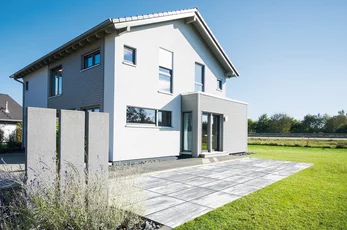
When choosing the type of slabs to be used for the surface, their size and shape are important. The main point is to select slabs or pavers that fit the previously designed surface. This is important because it significantly reduces the need to cut them to fit the intended layout. This task requires the use of a guillotine or a diamond blade saw, which further extends the project’s completion time. That is why it is recommended to use small elements on narrow paths. Conversely, wherever we are laying large areas, it is worth using large-format slabs. Such areas include terraces or driveways. A universal solution for laying curves, however, is trapezoidal pavers, which allow us to create smoothly curved arches.
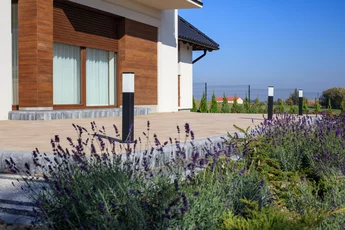
Once we have chosen the appropriate thickness and shape, the next thing to consider is the colour of the pavers or slabs. Importantly, it must match the character and architectural style of the house and its surroundings. Shades of grey, or korten, are recommended for modernist and Scandinavian-style designs. Warmer colours ranging from beige through to browns or a more intense yellow will suit garden surfaces with a rustic character or those with a Mediterranean feel.
We’ve made our choice, so we’re buying
Once we have checked that the paver or concrete slab meets the standards, has the correct labelling, and matches the intended use, style and colour of our design, we can proceed to purchase it. Pavers are usually sold on transport pallets, and in the case of some types, in so-called Big Bags, i.e. special bags (flexible containers) placed on transport pallets. When purchasing, it is worth arranging transport straight away, as a single pallet, depending on the size and thickness of the components, can weigh over a tonne. If you are laying paving over a large area, it is recommended to purchase all the material in one go to minimise minor differences between successive production batches. – To achieve the right interplay of colours on the laid surface and eliminate variations in shade over large areas, the pavers or slabs should be laid by mixing elements from at least three different pallets. “The production technology and the use of natural ingredients mean that the colour of the concrete may vary slightly within a single production batch,” explains the chief technologist at Polbruk.
Once the material arrives on site, it is also worth checking that the delivery is complete and that the order meets your expectations. It is also advisable to check that the delivered elements have not been damaged during transport. If everything is in order, you can proceed with laying the paving in your garden.