What are garden walls used for?
Garden walls serve many important functions and have a range of different uses. They can be used to separate different areas in the garden, e.g. a terrace from the garden. They can be used to screen off less decorative and less presentable parts of the garden. Garden walls are often used as retaining walls and help to level the ground on hilly terrain or create variation on flat ground. They prevent soil from slipping and provide excellent support for a slope planted with vegetation. Low walls allow you to create striking tiers in rockeries, which often owe their unique charm to them. They are also a good idea for unconventional flowerbeds. Low walls can also serve as garden furniture. They are often used as seats and utilised, for example, in the construction of a barbecue, as shelves by the stairs, or alongside fences.
What can they be made of?
There are many materials on the market that can be used to build garden walls. A wall should complement the garden layout and the style of the property, and blend harmoniously with the character of the space. Various types of stone are often used to build low walls, e.g. granite, quartzite, slate, sandstone, syenite, as well as concrete blocks, gabions, bricks, wooden logs and split blocks. The average height of a wall is approx. 40–100 cm. Walls 40–60 cm high can be built ‘dry’, i.e. without mortar or a foundation, whereas walls 60–100 cm high should be bonded with mortar. In such cases, it is advisable to construct a foundation 30–60 cm thick, and for taller walls, even 80 cm thick. It should be remembered that low walls are decorative elements and should not be too high.
Albero – a wall inspired by natural slate
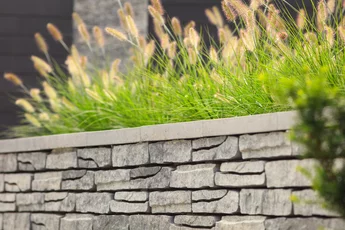
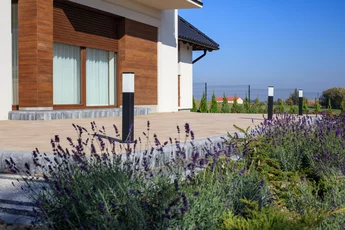
Walls made from precast concrete blocks are one of the more durable and cost-effective solutions available on the market. The Albero wall, inspired by rock slate, resembles historic structures from Tuscany in Italy. Albero works perfectly as a retaining wall, helping to level out differences in ground height around the house. Building the wall is not time-consuming, as it is constructed from ready-made modules measuring 7.7 cm in height, 18 cm in width and 41 cm in length. Albero modules can be used to build many small architectural features, such as a closed-circuit fountain or the aforementioned garden furniture. Thanks to its contemporary design, as well as its historicist character, it can become an element of garden landscaping in modern, rustic and Mediterranean styles. Albero in the colour alpen is best suited to the first two styles. In this case, the grey will contrast perfectly with the garden’s greenery. This is a highly desirable effect in designs following this aesthetic. Conversely, the colour brenta (beige-grey) will work well in projects where warm surface colours reminiscent of Mediterranean settings dominate.
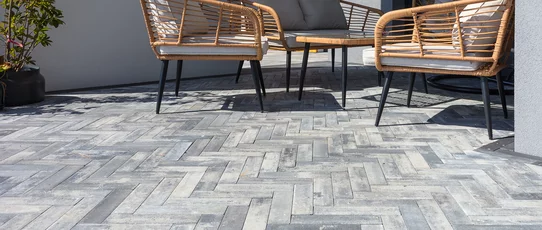
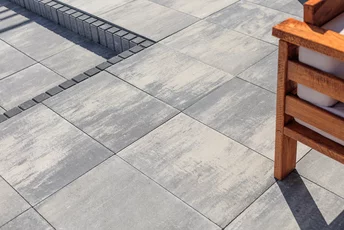
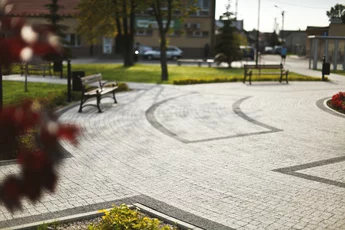
A low wall, like any element of small-scale architecture, is part of a larger composition, so it is worth choosing a visually consistent paving to match it. Albero in the colour alpen will harmonise perfectly with pavers designed for a modern style, such as Polbruk Oland, Metrik or Lamell On the other hand, a good complement to the Albero wall in the colour brenta would be pavers Polbruk Avanti, Granito, Ideo or Petra in warm Mediterranean shades.
What plants should be used to cover low walls?
Climbing or trailing plants are most commonly used for planting on low walls. Shrubs are often planted along low walls, such as creeping willows, cotoneasters or creeping junipers. Plant species that thrive on low walls include, amongst others, winter laurel, cinquefoil, quince, barberry, stonecrop, as well as mountain pine and dwarf varieties of spruce and pine. Perennials are ideal for planting on a wall: spiny stonecrop, saxifrage, sea thrift, spiny rockcress, garden rockcress, sedum, garden stonecrop, alpine stonecrop and common rockcress. In shady spots, periwinkle, common columbine, heart-leaved tiarella, creeping woodrush, plectranthus, heuchera, hosta and blood currant will thrive.
Low walls add character
Retaining walls are an attractive feature in any garden. They can help to visually enlarge the space. To make the garden appear longer, the wall should be lower at the far end, and may even ‘disappear’ into the ground. Long and irregular walls also encourage you to walk along their line and draw the eye to the far corners of the garden. In romantic, rustic-style gardens, they often look a little mysterious. In modern designs, they ‘organise’ the space and ‘guide’ the lines of the planting. Regardless of the chosen style, they always create a unique atmosphere of a private green haven.