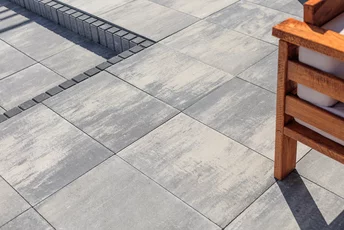
In modern architecture, a terrace serves as a bridge between the living room and the garden. It should provide a seamless transition between these two areas, which is why it is usually designed in a style similar to the home’s interior. Contemporary interior design is currently dominated by the modern style. At its core, it emphasizes simplicity, minimalism, and a color palette of white and gray tones. When planning a modernist-style terrace, we must take all these factors into account when selecting the appropriate materials for its construction. - Although the modern style does not shy away from wood and natural stone, concrete pavers and slabs are—due to their practical nature, durability, and ease of maintenance—definitely a more durable solution for terrace flooring, and in terms of design, often an even more interesting one. This is not only due to their technical specifications but also their rich design variety, which is constantly evolving,” emphasizes Wojciech Średniawa, Chief Designer at Polbruk S.A.
A modern terrace comes in many forms
In the modern style, the color scheme of the surface is usually kept in shades of gray, and the elements used to build the terrace have geometric shapes. Most often, these are squares, rectangles, and other polygons. Many solutions using precast concrete elements meet these criteria. – A particularly interesting option from our product line that’s worth noting is the “Polbruk” slab Exa. Its hexagonal shape is a modern take on the classic “honeycomb” pattern. In contemporary architecture, it has been successfully used in many modern buildings. It can be found on the facade of the La Trobe University in Melbourne, the Warmia Gallery in Olsztyn, a furniture store in São Paulo, Brazil, and many other locations,” says the architect. The “Exa” thus reflects the world’s leading design trends with its appearance. In this case, the hexagonal shape has been slightly modified by using edges of varying lengths. This lends the panel’s design a dynamic and somewhat extravagant look. Exa is available in the trendy “taupe” color (mokka—steel white) as well as “nerino” and features a smooth texture.
Another interesting option for a modern patio is the Polbruk Lamell slab, which comes with a smooth or washed texture and measures 60 by 40 cm. Its undeniable advantage is that it’s available in several color shades—from cool to warm. The selection of concrete patio slabs that complement modern architecture is truly extensive. Once you’ve chosen the one you like best, all that’s left is to build your patio with them.
Building a Terrace on the Ground
The quickest and easiest way is to build a patio on the ground. The first step is to mark out its area and boundaries—we do this by driving stakes into the ground and stretching a string between them. At this stage, it’s important to choose slabs of the right length and width to avoid having to cut them. This will definitely make the job easier. Next, remove a layer of soil to a depth of about 30 cm. After that, compact the soil and lay down a layer of gravel and sand. For a patio, which is usually made of pavers or 4-cm-thick slabs, the base layer should be about 20 cm thick. After this, tamp the soil again and spread a 3–6 cm layer of sand, which you then level. Next, we proceed to the final stage of our work. We lay the slabs on the previously prepared subbase and tap them with a rubber mallet so they settle into the bedding material. At this stage, it is important to maintain proper spacing between individual elements (the minimum spacing is 3 mm). This is extremely important for the final step, known as consolidation. This involves sweeping sand into the gaps and pouring water over it until the desired effect is achieved.
– An alternative to regular sand is polymer sand, such as DR+ NextGel. It is more effective, provides a better aesthetic and visual result, and makes it easier to keep the deck clean on an ongoing basis. Furthermore, joints made of regular sand tend to crack. They are prone to being washed out or blown away by the wind. Sand is also often contaminated with clay or dust, which can promote weed growth. This reduces the aesthetic appeal of the surface and also means it requires constant maintenance, with the grout needing to be replenished from time to time,” explains Wojciech Średniawa from Polbruk.
If you decide to install a deck directly on the ground, remember to maintain a 2–3 percent slope toward the garden. This will allow for effective drainage of rainwater. Remember to maintain proper spacing between the concrete slabs. This is extremely important, as failure to follow this recommendation negatively affects the performance of the surface under load or in high humidity and, in the long run, can lead to cracking of the slabs. It is also important to prepare the subbase properly. If it is not properly leveled, it can cause the paving elements to become loose or even sink.