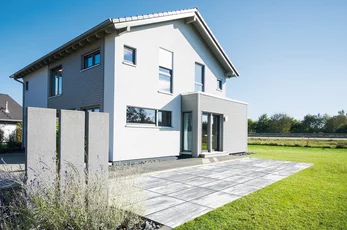
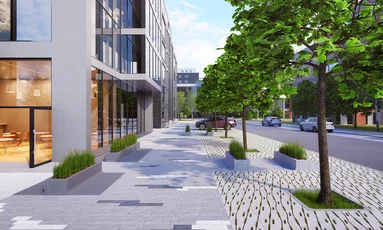
The basis of designing a modern-style garden is its proper layout, the correct marking out of paths, terraces and driveways, and the selection of appropriate materials and design elements. The property should also be surrounded by a fence that complements the overall design. Choosing the paving is the first step before selecting the other design elements. The most commonly chosen paving materials are concrete pavers and slabs. They have good technical specifications, are durable and robust, and require minimal maintenance to preserve their aesthetic appearance. A major advantage of this type of paving material is also the wide range of shapes and colours that suit modern designs. However, the paving is not the only element that can be made from precast concrete. To achieve an interesting visual effect in the garden, it is also worth considering the use of edging, planters, low walls, as well as steps and fences.
Terrace or driveway?
Before we begin designing paths, terraces and driveways, we must answer the fundamental question of where the slabs or pavers will be used. In this case, thickness is a very important technical parameter. For surfaces intended solely for pedestrian use, we can use slabs less than 6 cm thick. Such areas are usually terraces and paths. If we are considering a surface intended for both pedestrian and light vehicle traffic, the thickness of the paving should be between 6 and 8 cm. Slabs and pavers over 8 cm thick, on the other hand, are designed for high-traffic areas, as they can withstand the weight of lorries.
Rectangles, squares and honeycomb
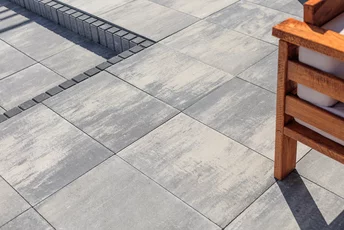
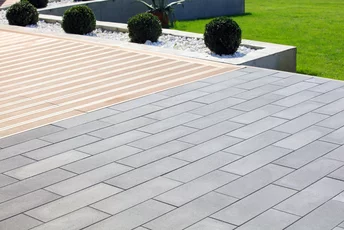
For many buyers, the most important feature of concrete slabs or pavers is their aesthetics and design. Here, the range of available options is truly wide. Geometric elements suit modern designs. Most slabs and pavers are rectangular or square in shape, though more sophisticated forms do exist. One example is the terrace slab Polbruk Exa, which resembles a honeycomb. Its hexagonal shape has been slightly modified by using edges of varying lengths, which gives the slab a dynamic and original appearance. Its dimensions are 4.5×56.3×43.2 cm. Exa is available in the fashionable colour taupe (mokka - steel white) and nierino. This is not the only colour to have gained popularity in modern designs. Melange greys are also very fashionable. For example, those featuring the Polbruk Lamell paving slab. It measures 4.5×60×40 cm and is available in a smooth finish in the colours: steel, nerino and foxtrot, and in a washed finish – ritmo_d. If you are looking for the perfect paving slab for a modernist-style driveway, it is worth considering the large-format slab Polbruk Magna. It has a rectangular shape and comes in two thicknesses: 8 and 10 cm. It is available in a grey melange colour scheme – nerino. If you are looking for more versatile solutions for terraces, paths and driveways, the Urbanika 60 slab is an excellent choice. Its versatility stems from its 8 cm thickness, making it suitable for terraces, paths and driveways for heavy goods vehicles. Additional advantages include its large 60x20 cm dimensions and a wide range of shades – nerino, onyx (smooth finish), graphite, grey, inez_d and ardo_d (washed texture). Choosing the right paving thickness for the intended use, along with the shape of the elements and the colours, is half the battle, but when designing a garden, the details also matter.
Edging, planters and low walls – key design
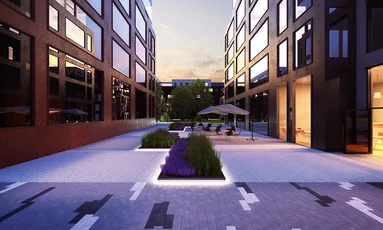
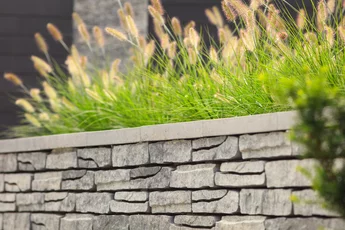
elements A modern garden is characterised by simplicity, so an excessive number of details is not advisable. Edging is a key element that organises the space and defines a clear boundary between the patio, paths and driveway. It is recommended that they be kept in a similar colour scheme to the rest of the garden. An interesting solution from a modern design perspective is the edging Polbruk Flesz. It has the shape of an inverted letter ‘L’ and comes in shades of grey and beige. Under its canopy, you can easily conceal LED strip lighting, which will effectively illuminate the garden paths at night. This not only adds decorative value and a magical effect but also improves safety when moving around the garden. Another detail that will enhance the design of a modernist garden are planters made from precast concrete elements. An example of such a solution is Polbruk Tigela, namely L-shaped modules that can be used to create spaces for plants in the garden. There are several ways to arrange them – on the longer or shorter side – which means that the planters made from them will vary in height. This allows for variation in the proportions of green accents within the design. An alternative to Tigeli, if you are considering creating spaces for plants in the form of planters, is the low wall Polbruk Albero or the Palisade Zen. The low wall Albero resembles the stone boundary walls between properties that can still be found today in Tuscany or Ireland. Building the wall won’t take much time, as it is made from ready-made elements. Each element is 41 cm high, 7.7 cm thick and 18 cm long. We’ll build the planter by arranging them into a square, filling the space between the sides with soil and plants. Another use Albero is as a garden wall to prevent soil from sliding down a slope. The palisade
ZENalso provides excellent protection against soil erosion. It is also ideal as a border separating different parts of the garden. The palisade ZEN has a minimalist, geometric design and a stone-like texture. It is available in a grey (grey, graphite) colour scheme. It comes in heights of 100 and 120 cm, allowing you to vary the height of the elements. It can also be used to build flower beds or planters.
A sure step up the stairs
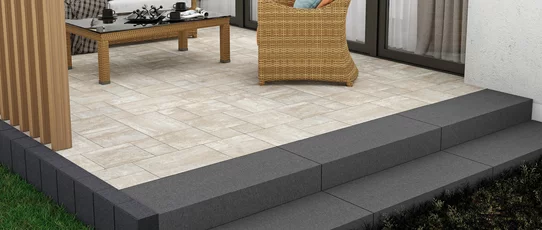
In some cases, the terrain around the property necessitates the use of stairs. External stairs are used in garden designs where the terrace meets the garden, or in places where it is necessary to ‘blend in’ differences in ground level. They should be stylistically consistent with the rest of the design, the chosen paving and the small architectural features. The concrete stair treads Polbruk Grando are particularly noteworthy. They are available in a single smooth finish. Due to their width and length, they can be arranged in larger or smaller configurations. The dimensions of a single step are 15×37×100 cm. Installation is very straightforward. They do not require a concrete substructure.
Fencing matters
Fences can also be constructed using precast concrete elements. For modern designs, a fence Polbruk Neo, built from 20x60 cm concrete blocks, will be a good fit. The fence modules are 10 cm high, have a geometric rectangular shape, a smooth texture and come in shades of grey (grey and graphite). If you wish to maintain maximum privacy on your property, you can erect a high wall using the elements from Neo, which can be adorned with climbing plants such as Virginia creeper, ivy, grapevine or fragrant jasmine. If you prefer a little more light to enter the garden, metal or wooden panels can be inserted between the hollow block posts. In either case, the wall should be topped with a flat 5 cm-high coping to protect the structure from the elements.
Concrete elements can form a significant part of the landscape architecture surrounding a modern home. Of course, the vegetation is also extremely important; in the modernist style, it should be lush and green to provide a contrast to the paving and other elements of the small-scale architecture.