They are openwork or feature special protrusions, geometric shapes and, most often, neutral colours. Openwork concrete blocks and slabs are increasingly common today in urban spaces and on private properties.
This is because solutions that allow water to permeate into the ground have become very fashionable in architecture. These include surfaces made of concrete elements, between or within which there are biologically active spaces, most often filled with gravel or sown with grass. Thanks to this, water is drained directly into the ground, which is beneficial for plant growth. Water accumulation in the soil increases air humidity and, in summer, also lowers the ambient temperature. Furthermore, open-jointed pavements protect the area from flooding caused by heavy downpours, thereby relieving the burden on the stormwater drainage system. They ensure that the surface of the road or pavement dries out more quickly, which provides greater safety for users. The use of this type of paving is also gaining popularity because it allows for an ‘increase’ in the potential building area specified in the local spatial development plan. The biologically active spaces within the openwork pavers or joints are classified as green areas. These can account for anywhere from a dozen or so to several dozen per cent of the pavement or parking space area, thereby providing additional square metres for building development. Permeable surfaces have become fashionable because, apart from the typical openwork slabs usually used in car parks, there is a wide range of designer products to choose from, which increases their appeal to architects.
Perforated and designer
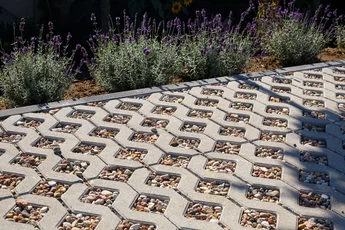
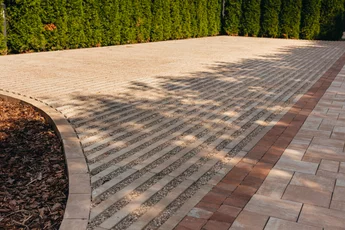
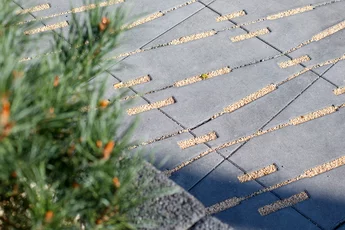
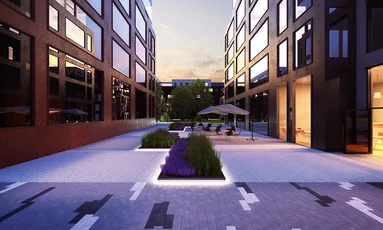
Today, openwork concrete elements are not limited to the ‘Meba’ slab, which has reigned supreme in car parks for years. Characterised by a minimalist, geometric form with square-shaped openings, it comes in three well-known colours – graphite, grey and red. Although it is highly permeable – as much as 40 per cent of the surface built with it constitutes a retention area – and versatile – as both cars and lorries can drive on it – it is also worth exploring other market solutions. Tech’s Retancja+openwork slab has recently made its market debut. When using Tech slabs, the biologically active surface area can reach as much as 50 per cent! It is ideal for use in residential and private car parks, local roads and driveways. The slab measures 40x60 cm and has a lattice-like appearance, with the horizontal elements set lower than the vertical ones. As a result, once the surface has been laid and the empty spaces filled with soil, only the lines are visible, with biologically active zones in between. The openings can be partly filled with gravel and partly sown with grass, creating strips of different colours. Tech Retencja+ blends very well with solid slabs, with which it creates highly attractive compositions. In particular, it is worth using it in combination with such popular products as Polbruk Triada or the large-format Polbruk Magna. Of course, there are many more potential combinations, especially as this slab is available in three colours: grey, graphite and latte. A design solution just as innovative as creating a hybrid surface from openwork and solid elements is the use of Polbruk Extrano slabs. These are unique square slabs with a 50 cm side, available in shades of grey (nerino, grey, graphite), featuring cut-out patterns resembling cubist ears of corn or tiger stripes. In the paving laid with these slabs, one can also discern inspiration from futuristic spaceships from science-fiction films. Especially when we illuminate the driveway or footpath at the sides using LED strips mounted in the edges of Flesz. The holes that give Extrano an extravagant look have another, more practical function. As with other openwork elements, they increase the retention area in the surrounding area and allow water to drain directly into the ground. However, openwork slabs with holes are not the only way to create a permeable surface.
Tabs make the difference
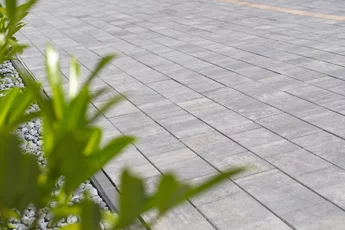
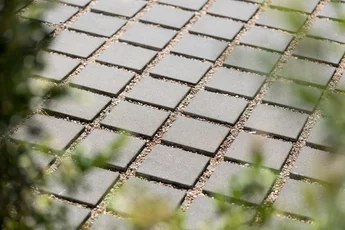
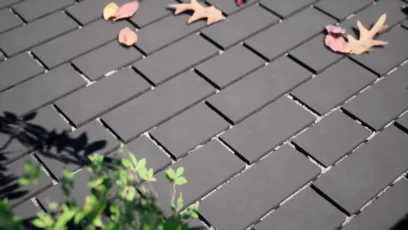
For several years now, slabs with protrusions on the sides have been gaining popularity; these force the creation of empty spaces between the paving elements. This is a technique designed to create wider ‘joints’ between the slabs, which makes the surface permeable. An example is the Equol paver from Polbruk. At first glance, it is a rather unassuming square paver with a 20 cm side, but it is incredibly versatile. It resembles old-fashioned pavers in appearance, which is why it works perfectly in historic city centres, whilst also fitting in well with minimalist, modern designs. It is available in grey and graphite and can be used to construct pedestrian areas, parking spaces, driveways or road surfaces capable of withstanding vehicles weighing over 3.5 tonnes! Biologically active zones in a surface constructed from Eqol pavers account for approximately 27 per cent of the area. An alternative to this, but only in areas designated for pedestrians and passenger cars, is this year’s new product, Triada Retencja+. This system consists of three slabs of different sizes. The smallest measures 20x30 cm, the medium 20x40 cm, and the largest 20x50 cm. Like Eqol, they feature spacers that create biologically active spaces. They account for approximately 14 per cent of the surface area, as the ‘green joints’ are narrower than those in Eqol pavers. Triada Retencja+ is available in three shades of grey: nerino, grey and graphite, which on the one hand makes it very versatile, and on the other offers several interesting options. For example, you can create a surface using two single colours simultaneously or combine it with a solid surface made of Triada pavers of the same dimensions.
Conscious choices, step by step
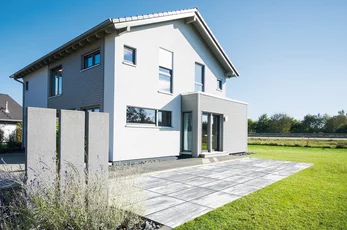
Another interesting solution is to lay the paving using the step-by-step method. This method involves laying the slabs at a certain distance from one another. The distance should be roughly equal to the length of a human stride, so that walking on such a surface is comfortable. The spaces between the slabs are usually filled with gravel or sown with grass, thus creating a living surface. This method of paving works perfectly on driveways, footpaths, and as a border around the house. Slabs combined with gravel are a good solution for entrance areas, driveways and as a perimeter strip, whilst combined with grass they are ideal for garden paths, in parks, and also for driveways around the house. When constructing a surface using the step-by-step method, large-format slabs, such as the aforementioned Magna, are the most functional. This is one of the largest slabs available on the market, as it measures 100x75 cm and 75x50 cm and comes in two thicknesses: 8 and 10 cm. The biologically active surface area of a paving laid using this method is variable and depends on the spacing between the slabs. Another interesting solution, where we can influence the size of the biologically active space, is the Magna slab, which can be used to create a solid surface, but also allows for gaps to be left between individual elements. The more gaps there are, the greater the permeability of the surface.
The sub-base matters too
In addition to the percentage of open surface area, the sub-base on which the pavers and slabs are laid also influences good water retention. The sub-base is an important part of the surface structure responsible for transferring loads from the surface to the ground. Instead of ordinary concrete for the sub-base, it is worth using porous concrete or suitable aggregate, which allows water to drain into the soil more quickly and, if necessary, retains rainwater and meltwater.
The growing popularity of permeable surfaces is only natural, as the trend towards sustainable design of domestic and urban spaces is currently gaining momentum. This increases the likelihood that environmentally friendly solutions will be adopted in new housing developments. Interestingly, the presence of greenery in the building’s surroundings is becoming increasingly important to homebuyers. A surface with a biologically active area where grass grows can also help to meet these requirements to some extent. Furthermore, surfaces laid with this type of slab and paver can have a truly stylish appearance and look very prestigious.